
Debt financing rises to 474 million US dollars as the telecom operator reduces its reliance on shareholder capital while working towards operational break-even.
Safaricom Ethiopia’s cumulative funding has reached 2.84 billion US dollars, with borrowing accounting for a growing share of its financing as the country’s second telecommunications operator shifts away from its earlier reliance on shareholder equity to fund network expansion and operating losses.
The latest financial disclosures from Safaricom Group, released on 5 November 2026, show that the Ethiopian operation had secured approximately 2.37 billion US dollars in equity and 474 million US dollars in debt by the end of September 2026.
Of the total borrowings, 311 million US dollars was denominated in foreign currencies, while 163 million US dollars came from local-currency financing.
Debt now represents approximately 16.7 percent of the company’s total disclosed funding and is equivalent to 20 percent of shareholder equity, marking a shift in the financing structure of one of Ethiopia’s largest foreign investment projects.
Total funding increased by approximately 193 million US dollars over the six months from March 2026, when the company reported cumulative funding of around 2.65 billion US dollars.
The financing transition comes as Safaricom seeks to strengthen the Ethiopian subsidiary’s ability to borrow against its own financial position rather than depending primarily on additional capital injections from its international shareholders.
Safaricom Group Chief Financial Officer Dilip Pal said the company had deliberately introduced borrowing to optimise its capital structure after initially financing the Ethiopian venture almost entirely through equity.
The strategy also reflects the changing financial requirements of the business as it moves from its initial infrastructure rollout towards expanding revenue from its existing network.
Safaricom Ethiopia is operated through the Global Partnership for Ethiopia consortium, which includes Safaricom, Vodacom Group, Japan’s Sumitomo Corporation, British International Investment and the International Finance Corporation.
The consortium entered Ethiopia after securing the country’s first privately held telecommunications operator licence in 2021, ending the longstanding monopoly of state-owned Ethio telecom.
The investment includes an 850 million US dollars telecommunications licence fee and a further 150 million US dollars paid for the company’s mobile money licence. These licence payments form part of the cumulative funding disclosed by Safaricom and should not be treated as additional investment beyond the reported total.
The growing use of debt also introduces financing obligations that differ from shareholder contributions. Unlike equity, borrowing generally requires scheduled repayments and interest payments, making the company’s ability to generate sufficient operating cash flow increasingly important.
Foreign-currency borrowing also creates exposure to exchange-rate movements, particularly where liabilities are denominated in US dollars while most operating revenue is generated in Ethiopian birr. Local-currency financing can reduce the direct currency mismatch associated with foreign loans, although its cost and repayment terms depend on the underlying agreements.
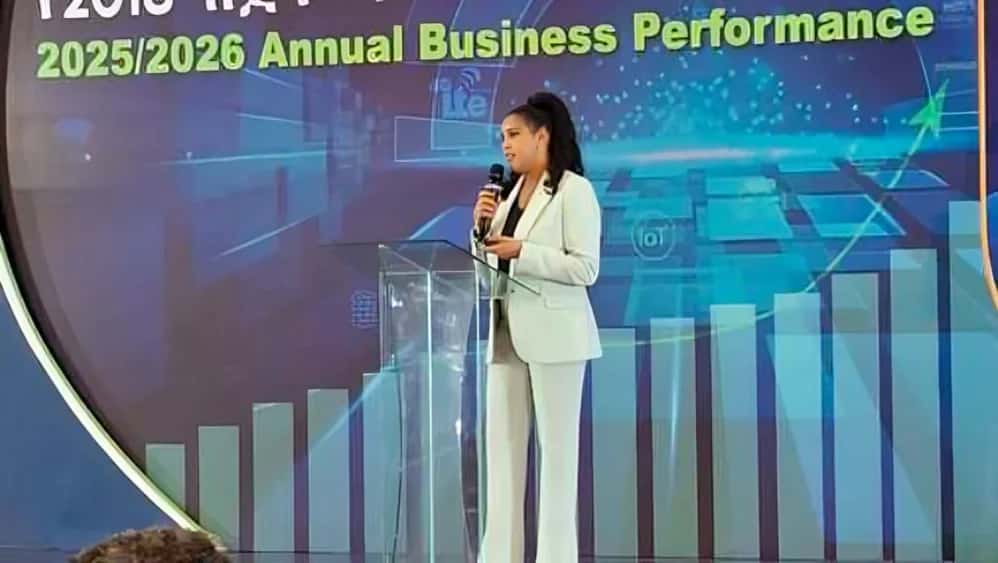
The change in funding structure coincides with a sharp improvement in Safaricom Ethiopia’s operating performance.
For the six months ended 30 September 2026, the company recorded a 71.6 percent increase in service revenue to 10.6 billion Kenyan shillings, equivalent to approximately 13.1 billion birr.
Its loss before interest, taxes, depreciation and amortisation, commonly referred to as EBITDA, narrowed by 96.5 percent to 434.4 million Kenyan shillings, compared with approximately 12.5 billion Kenyan shillings in the corresponding period last year.
However, the company continued to record substantial losses after accounting for depreciation and other operating expenses.
Its loss before interest and tax stood at approximately 11.4 billion Kenyan shillings, although this represented a 53.4 percent reduction from the previous year.
The difference between the two measures reflects the continuing financial burden associated with the company’s telecommunications infrastructure, including network equipment and other long-term assets.
Safaricom Ethiopia’s active customer base reached approximately 15.4 million during the reporting period, supporting increased mobile data consumption and service revenue.
The company has maintained its target of achieving EBITDA break-even by March 2027, when its current financial year ends.
Achieving that target would mean the operation no longer records losses at the EBITDA level, although it would not necessarily indicate that the subsidiary has become profitable after depreciation, financing costs and taxes.
The financing shift also follows changes in Safaricom’s ownership of the Ethiopian business. Earlier capital contributions by Safaricom and Vodacom increased their combined influence over the venture, while reducing the proportional ownership of other consortium members.
Safaricom’s effective stake in the Ethiopian operation rose to approximately 54.1 percent by March 2026, following additional shareholder funding.
The introduction of a larger debt component provides an alternative to repeated equity injections, which can change ownership proportions when existing shareholders do not contribute equally to additional fundraising.
The company’s ability to sustain this approach will depend on future revenue growth, the cost of borrowing, foreign-exchange availability and progress towards generating sufficient cash flow from its Ethiopian operations.
For Ethiopia’s telecommunications sector, the funding structure represents a significant development in the financing of private infrastructure investment. Safaricom’s initial market entry relied heavily on international shareholder funding, while its expanding borrowing arrangements now include both domestic and foreign lenders.
The latest results show that shareholder equity remains the dominant source of financing, accounting for more than four-fifths of the reported total, even as debt assumes a larger role in supporting the company’s operations and future investment requirements.